.svg)


.svg)


Deliveries to sites without docks — such as city retail stores, offices or construction sites — demand extra planning in France. Unlike standard shipments into warehouses, no-dock deliveries rely on truck tail lifts and pallet jacks, and must navigate narrow streets, low bridges, and emissions zones. Typical receivers include small shops, offices, urban warehouses and city-center projects. Because there's no forklift or dock, the risks of failed first delivery attempts, waiting charges, cargo damage or safety incidents (e.g. slips, falls from tail-lifts) are higher. For example, without verification of unloading conditions, shipments can be refused or rescheduled, and tail-lifts carry safety risks unless proper precautions (rails, cones, hi-vis) are used.
Site constraints to capture before booking
Before delivery, gather detailed site information to prevent issues. Record truck limits (height, weight, width) and turning space. In Paris and other cities trucks over 12–16.5 m may be banned or restricted (e.g. only allowed at night). Many French cities have Low Emission Zones (ZFE) requiring a Crit’Air sticker on the truck, and Paris will ban diesel vans from curbside deliveries by end-2024. Note nearby delivery bays or yellow-zoned parking: Paris allows 30-minute stops only and drivers must display the start time.
Measure doorway and gate widths (standard Euro-pallet is 120×80 cm). Check for steps or thresholds (pallet jacks need flush, level surfaces). Confirm any ramps or elevators and their capacity/dimensions. Verify floor strength if heavy loads go upstairs. Even a slight slope or rough pavement can double the effort of a pallet jack, so note surface type (cobbles, gravel) and gradient.
Learn the receiver’s opening hours and booking rules. Many locations in France require scheduled slots or specific time windows. In Paris, large vehicles can only load at night and most zones use 30-min max loading periods. Find out security/reception protocols and have an on-site contact and phone number ready.
Surface & gradient: The unloading area must be flat, solid ground. Tail-lifts cannot operate on gravel, grass, or steep inclines — pallet trucks simply won’t move. Check for curbs or gutters: the truck bed must reach level ground to use the lift safely. Also note exposure to weather (wet or icy ramps greatly increase slip hazards).
Equipment & handling (tail-lift + pallet-jack)
Select the right gear and follow safe unloading steps.
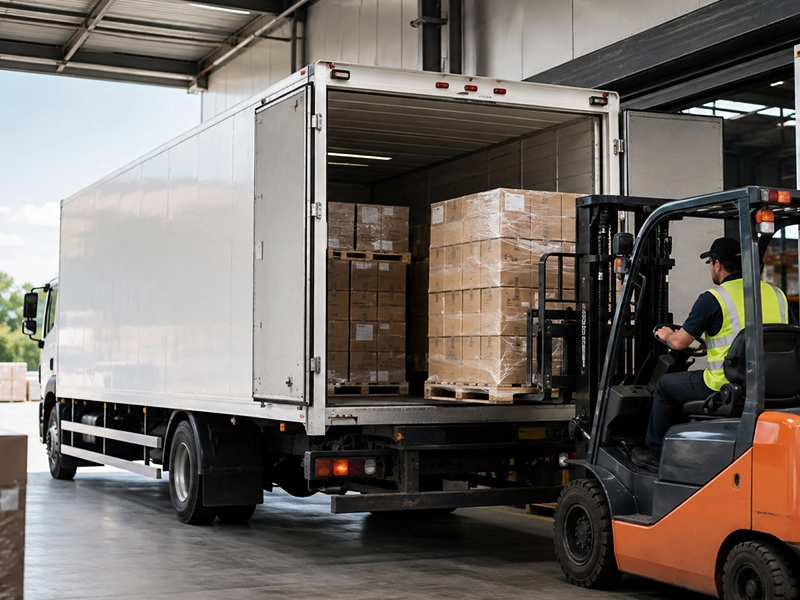
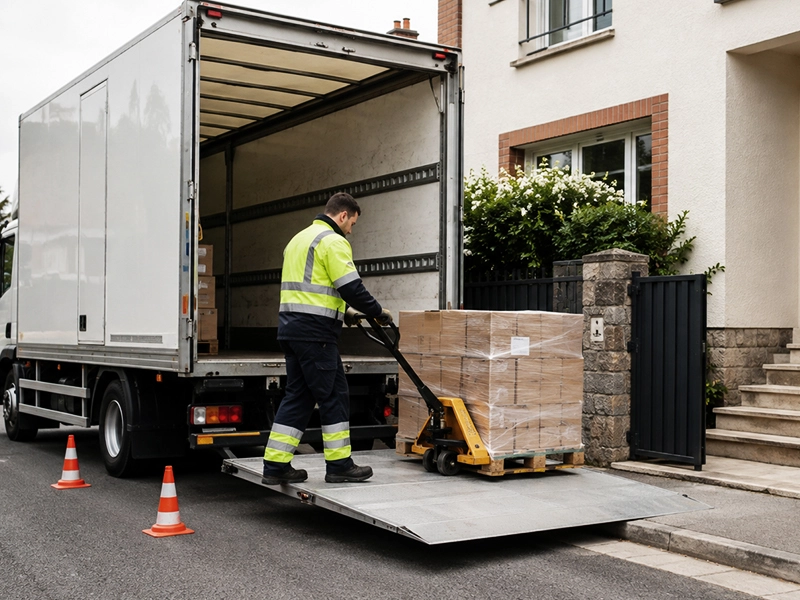
- Tail-lift basics: A tail-lift (liftgate) is a truck-mounted platform that raises/lowers pallets. Its capacity varies by vehicle — often around 1,000 kg per lift (some go up to 1,500 kg) — so always confirm limits against your pallet weight. The platform size (typically ~2×2 m) must accommodate the load. The truck must be parked on level ground for safe operation, with cones/barriers securing the area. Drivers should wear PPE (hi-vis, gloves) and ensure no pedestrians are in the lift zone. If at any point the driver deems conditions unsafe, they should stop and reschedule.
- Pallet-jack use: Once lowered, pallets are moved by hand using a pump (pallet) jack. These jacks have small wheels and only work on smooth, flat surfaces. Maximum pallet dimensions should be agreed in advance (oversize pallets may not roll under doorways). Avoid any overhang on the platform. The shipper should mark whether pallets are stackable or fragile. Two-person teams may be needed for bulky or heavy loads to push the jack safely.
- Load securing & sequence: Always strap the pallet on the platform and use anti-slip mats as needed. Lower one pallet at a time to the curb or threshold. Once on ground level, unstrap and place it on the pallet truck. Unload in a logical order (often from back to front). If unloading on uneven ground, use plywood or board as a ramp for the jack.
Service definitions & charges (set expectations)
Clarify exactly what level of service is booked and any extras. The table below compares the three main delivery types:
Booking & communication playbook (France)
Maintain clear, proactive communication to ensure smooth delivery.
- Contact the receiver in advance to confirm the delivery slot, needed equipment (tail-lift, lift truck), and any site constraints (gate code, dock location, etc.). Verify contact person and phone. Share key details (pallet count/weight, truck size) and ask if any special arrangements (e.g. booking a lift or parking pass) are needed.
- In your booking system or truck manifest, include: consignment ID, number of pallets, weights and dimensions, stackable Y/N, plus concise notes on site restrictions (e.g., “door width 2m”, “no dock — tail lift required”). If available, attach photos or a map pin of the loading point. This centralized info ensures all parties know what to expect.
- Paris and other large French cities have special rules. Yellow-painted loading zones allow 30-minute stops (tracked by parking disc). Long trucks are banned during day hours in Paris (over 16.5 m forbidden; 12–16.5 m only allowed at night). Vehicles in city cores must display the proper Crit’Air emissions sticker. Always check the local “règlement des transports” or municipal bylaws.
Safety & documentation
Drivers should wear high-visibility clothing and safety footwear, and use traffic cones or barriers around the tail-lift. Ensure bystanders (pedestrians, other vehicles) are kept clear during unloading. Work on inclines or unstable surfaces is dangerous — if ground is unsafe, refuse or reschedule the delivery.
Use electronic Proof-of-Delivery or eCMR systems to capture the drop-off. Record the exact time and GPS location. Crucially, take photos of the goods and the drop point both before and after unloading. Capture images of the pallet on the truck, on the tail-lift, and at its final position. Note on the POD/CMR any shortages, damage, or deviations from plan.
If goods are damaged or conditions change (e.g. blocked entrance), isolate the affected pallet(s) and photograph them. Notify your control tower and the receiver promptly according to your terms. Document the exception on the paperwork. Proper documentation protects all parties in case of claims.
KPIs & continuous improvement
Track delivery performance and refine processes. Monitor metrics like first-attempt delivery rate, detention minutes per stop, damage rate, and customer satisfaction. High detention or damage rates flag problems in planning. Use surveys or feedback forms to measure receiver satisfaction.
After each delivery, update your site-survey notes. If a constraint or risk became apparent, record it in your system for next time. Refine default service levels or accessorial charges per receiver based on experience. Over time, these improvements — such as adding guard rails or updating truck assignments — will raise your on-time delivery scores and cut costs.
Frequently Asked Questions (FAQ)
What information do we need from a no-dock site in France?
Collect all access details: truck height/weight/width limits and turning space, low bridges or ZFE restrictions (Crit’Air zones), and locations of delivery bays or parking. For the building: doorway width and step height, presence and size of ramps or lifts, and floor surface type. Get the normal delivery window and whether an appointment is needed. Finally, obtain an on-site contact name/phone, and note any security or reception procedures.
Is tail-lift capacity standard?
No. Tail-lift strength depends on the truck and lift model. Many tail-lifts are rated for about 1 tonne (1,000 kg) per lift, but some heavy-duty ones handle up to 1.5 tonnes. Always confirm the exact capacity and platform size at booking so it matches your pallet weight and dimensions.
Can a pallet-jack move over ramps, gravel or cobbles?
Only on flat, hard surfaces. Pallet jacks have small wheels and will stall or slip on steep grades, gravel, cobblestones, grass or uneven pavement. If the site has slopes or rough ground, plan to use alternate equipment (like a powered stair climber or additional manpower) or deliver by other means.
What’s included in “curbside” delivery?
Curbside delivery (also called curb-to-gate) means the driver unloads the pallets to the nearest curb, dock or entrance, but does not carry them inside. It does not include bringing goods into the building. (Threshold delivery — to the first dry sheltered area — and inside room-of-choice services cost extra.) A threshold delivery moves items into a covered entryway to protect from weather.
How do we avoid detention and failed attempts?
Prevention is key. Confirm all site constraints before dispatch: pre-call the receiver to verify gate access, tail-lift needs, and contact details. Book an explicit delivery window and communicate any surcharges for delays or extra labor. With accurate access notes and a ready-to-receive contact, you minimize no-shows and waiting. On the day of delivery, stick to the booked slot and have pallet labels or shipping docs that match the truck’s capacity.
How should we document the delivery?
Use an electronic POD or consignment note to record the drop. Note exact times, GPS location, and who signed. Critically, take photos as proof: snapshot the pallet on the tail-lift, on the ground, and where it’s placed. If the goods were left at curb or had any issues, capture that too. Any exceptions or damages should be logged on the ePOD/CMR with comments. Good photo-documentation and data alignment between the booking and the ePOD (weight, dims, stackability) will support claims and continuous improvement.
Quote and book your transport across Europe


This route is currently inaccessible.
Unfortunately, our fleet does not run on some routes. To continue placing a transport order, please select another route.
Something went wrong...
Refresh the page and try again. If the problem persists, please contact us.



.webp)